Silver Spring Roofing Company and Columbia MD Contractors: What to Ask and What to Expect
Silver Spring Roofing Company and Columbia MD Contractors: What to Ask and What to Expect
Key Takeaways
- All Maryland roofing contractors must hold an MHIC license — verify at mhic.maryland.gov before signing anything
- Roof replacement in Silver Spring and Columbia MD runs $10,000–$24,000 for asphalt shingles in 2026
- Montgomery County and Howard County both require permits for full replacements — your contractor should pull them
- Get everything in writing: bid scope, material specs, warranty terms, and the change-order process for decking surprises
- Storm chasers spike after major weather events — verify local references before any post-storm hire
Your roof holds up against some of the harshest weather the mid-Atlantic can deliver. Silver Spring winters bring ice storms that force water under shingles. Columbia summers push attic temperatures past 130°F, accelerating granule loss on aging asphalt. When something goes wrong — a leak after a storm, cracked and curling shingles, or a gutter pulling away from the fascia — you need a silver spring roofing company you can trust to diagnose the problem honestly, price it fairly, and do the work properly the first time.
The Silver Spring and Columbia MD roofing market is active and inconsistent. There are excellent local contractors with deep roots in Montgomery County and Howard County, and there are fly-by-night crews that show up after storms, offer unusually low bids, and disappear before you realize the work was substandard. This guide tells you exactly what to ask, what an inspection should cover, what fair pricing looks like, and what red flags to watch for before you let anyone climb your roof.
What Makes Silver Spring and Columbia MD Roofing Different
Silver Spring and Columbia sit in a climate zone that puts unusual stress on roofing systems. Montgomery County and Howard County homes deal with more frequent freeze-thaw cycling than markets to the south, particularly in February and March when temperatures swing above and below freezing within 24 hours. That cycling forces water into micro-cracks in aging shingles, expands them, and accelerates deterioration year over year. Ice dam formation at the eave — where roof heat melts snow that refreezes at the cold overhang — is a recurring problem in Silver Spring neighborhoods built in the 1970s and 1980s, most of which lack the ice and water shield that modern code requires at the eave.
The housing stock is also notably diverse. You’ll find original Cape Cods and split-levels in Wheaton and Four Corners alongside newer construction in River Hill and Owen Brown. Some of Columbia’s older village communities have homes with complex rooflines — multiple dormers, intersecting valleys, and low-slope sections — that require different waterproofing approaches than a simple gable. A contractor who services this market needs to understand that complexity, not just install standard shingles on a straightforward hip roof.
Columbia’s planned community design creates another layer of complexity: many neighborhoods are governed by HOAs that regulate roofing material colors and sometimes specific products. A knowledgeable roofing contractor Columbia MD will be familiar with typical HOA requirements and can guide you toward compliant material options before you sign a contract — not after the material arrives on a flatbed.
Questions to Ask Before Hiring a Silver Spring Roofing Company
Maryland has specific licensing requirements that Virginia does not share. Every roofing contractor working on a residential property in Maryland must hold a valid Maryland Home Improvement Commission (MHIC) license. This is not optional and is not interchangeable with a Virginia contractor license. If a company cannot provide their MHIC number on demand, do not hire them — you can verify any MHIC license at mhic.maryland.gov in under a minute.
Beyond the license, ask every contractor these questions before allowing them to bid:
- Do you carry general liability and workers compensation? Ask for a certificate of insurance naming you as additional insured. Workers comp protects you if a crew member is injured on your property.
- Who actually does the work? Some contractors broker the job to a crew they’ve never used before. Ask whether the installers are employees or subcontractors and whether you can meet the foreman before work begins.
- What exact product are you proposing? “GAF shingles” is not a spec. Ask for the product name — GAF Timberline HDZ, Owens Corning Duration, CertainTeed Landmark Pro. Each has different warranty terms, wind ratings, and price points.
- What does your workmanship warranty cover and for how long? There are two warranties: the manufacturer’s material warranty and the contractor’s workmanship warranty. Get both in writing with specific terms, not just “we stand behind our work.”
- Will you pull the permit? Montgomery County and Howard County require permits for full replacements. The contractor should pull it. If they suggest skipping the permit or ask you to pull it yourself, walk away immediately.
- Can you give me three local references from the past 12 months? Ask for references in Silver Spring, Columbia, Bethesda, or Rockville. Call them. Ask what the crew left behind, whether the final bill matched the quote, and whether they’d hire the company again.
What a Proper Roof Inspection Covers
A thorough inspection takes 45 minutes to over an hour depending on roof complexity. Be skeptical of any contractor who “inspects” your roof in 10 minutes and immediately quotes a replacement. A proper inspection covers:
- Shingle surface condition — granule loss visible as dark patches or granules in gutters, cracking, curling at edges, cupping, and exposed fiberglass mat
- All flashing points — chimneys, pipe boots, skylights, and wall intersections are the most common leak origins; the inspector should physically check each, not eyeball from a ladder
- Ridge and hip caps — these take the most UV exposure and wind stress; missing or cracked ridge caps are a common source of leaks that appear to come from elsewhere
- Gutter attachment and drainage — gutters pulling from the fascia, overflowing, or holding standing water indicate drainage problems that accelerate rot and allow water intrusion at the roof edge
- Attic inspection — the underside of the decking reveals active water penetration; staining, soft spots, or visible daylight through decking are immediate findings requiring action
- Ventilation assessment — inadequate soffit and ridge ventilation traps heat and moisture, cutting years off any shingle’s rated life; a good inspector notes this and explains the impact on your project
After the inspection, a reputable company provides written findings — not just a verbal summary in the driveway. That record protects both parties and gives you something concrete to compare between bids. See our roofing contract checklist for everything that should appear in writing before work begins.
Roof Replacement Cost in Silver Spring and Columbia MD
Maryland roofing costs run slightly above national averages due to the state’s licensing requirements, permit costs, and the strong labor demand in the DC metro market. Here are realistic 2026 ranges for Silver Spring and Columbia:
| Service / Material | Low End | High End | Notes |
|---|---|---|---|
| Asphalt shingle replacement (avg. home) | $10,000 | $20,000 | 1,800–2,500 sq ft, labor + materials + tear-off |
| Architectural/dimensional shingles (upgrade) | $12,000 | $24,000 | Adds 5–10 years of rated lifespan vs. 3-tab |
| Metal roof — standing seam | $20,000 | $42,000+ | 40–60 year lifespan; best for complex rooflines |
| Decking replacement (if needed during tear-off) | $70/sheet | $120/sheet | Often unknown until tear-off; confirm billing method upfront |
| Montgomery County building permit | $130 | $350 | Required; contractor should pull this |
| Howard County permit (Columbia) | $100 | $280 | Required; verify who pays in the contract |
Prices shown are typical ranges for Silver Spring and Columbia MD as of 2026 and vary based on home size, material grade, decking condition, and current material costs. Contact us for a free on-site estimate.
What a Proper Bid Must Include
Maryland MHIC regulations require a written contract before work begins. But beyond the legal requirement, a detailed written bid is your primary protection against scope creep and surprise charges on roof replacement columbia md projects. Every bid should include:
- Complete tear-off of existing shingles and underlayment down to the decking, with the number of existing layers specified
- Disposal of all removed material — confirm this is included; some contractors dump it onsite and charge separately
- Ice and water shield at all eaves (minimum 3 feet, ideally 6 feet in ice-dam areas) and in all valleys
- Synthetic underlayment on the field — not 15-lb felt, which tears and fails under heavy Maryland rains
- New drip edge at eaves and rakes — frequently omitted on low bids to cut material cost
- New flashing at all penetrations: chimneys, pipe boots, skylights, and all wall intersections
- Exact shingle product name, color, and warranty class
- Who pulls the permit and who pays for it
- Project start and estimated completion dates
- Payment schedule tied to milestones — deposit, progress, final
- Both warranties documented: manufacturer material warranty and contractor workmanship warranty
Red Flags to Watch for When Hiring in Silver Spring or Columbia
- Door-to-door solicitation after storms. Professional local contractors do not knock on doors after hailstorms. If someone you did not call is at your door with a “limited-time offer,” that is a storm chaser — check their MHIC license before the conversation goes any further.
- Large upfront payment requests. A 10–25% deposit is normal. Requests for 50% or more before work begins are a warning sign. Some crews take full payment and never return.
- A bid 30–40% lower than the others. A dramatically low bid means fewer layers of underlayment, thinner ice and water shield, skipped drip edge, or a cheaper shingle than quoted. When you learn the real price, it will be in the form of a premature failure.
- No verifiable local address. A P.O. box and a website with a stock photo map are not a local presence. If a company has no verifiable physical address in the area, you have no way to find them when you need a warranty claim honored.
- Reluctance to provide local references. Any silver spring roofing company that has been in the market for more than a year should have dozens of local references. If they struggle to produce three, that tells you something important about their history in this market.
Repair or Replace? How to Know in the Silver Spring and Columbia Market
One of the most common questions homeowners in Columbia ask is whether to repair or replace, especially with a roof that is 15–18 years old. The answer depends on a few factors:
- Age relative to the warranty class: A 20-year architectural shingle at year 18 has used most of its rated life. Repairing it now means doing it again in two years before you still need a replacement. The math almost always favors replacement at that stage.
- Extent of granule loss: Granules protect the asphalt from UV degradation. Once granule loss is widespread across the field, not just localized to one damaged area, the shingles cannot be meaningfully extended by patching.
- Number of active leak points: One isolated post-storm leak is a repair. Multiple ceiling stains in different rooms after rain indicates systemic failure — that is a replacement indicator regardless of roof age.
- Insurance involvement: If you are filing a storm damage claim, an adjuster will note overall roof condition. Get a written inspection report from your contractor before the adjuster visits — it documents findings objectively and protects your claim.
Our roof replacement cost guide walks through how to estimate full replacement pricing so you can make an informed repair vs. replace comparison with real numbers.
Free Estimates for Silver Spring, Columbia, and Maryland DC Metro
Sterling Roofers serves Montgomery County, Howard County, and Northern Virginia. MHIC licensed, fully insured, and GAF certified. Call (703) 436-4445 or book online.
Book Your Free EstimateWhat to Expect on Project Day
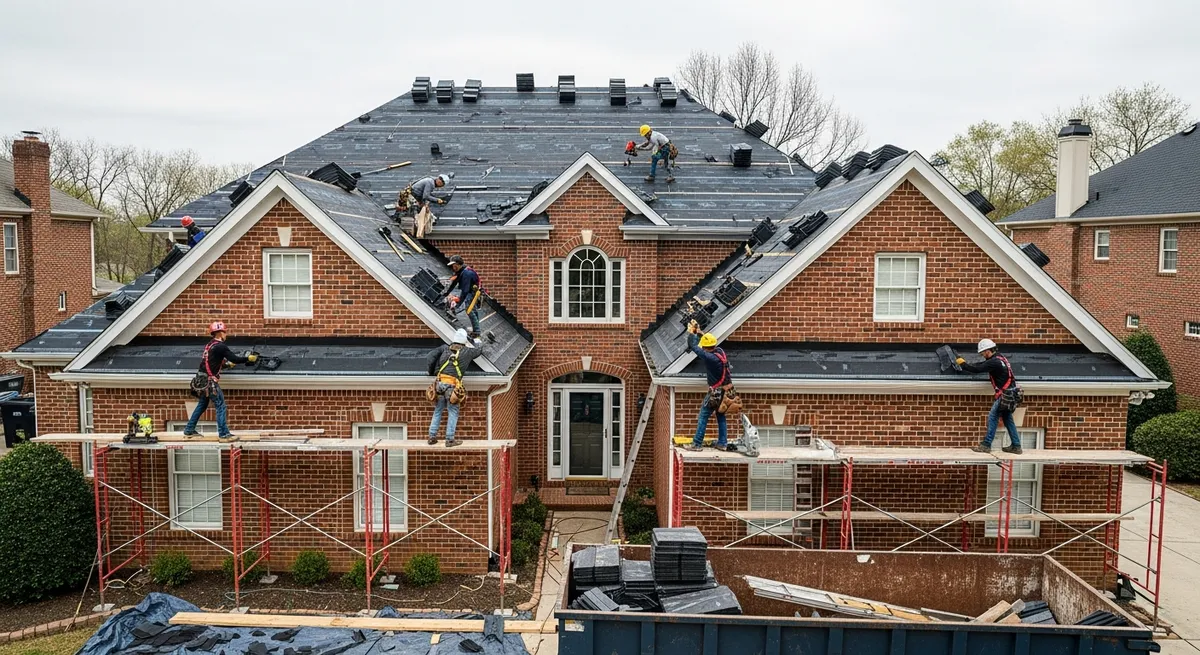
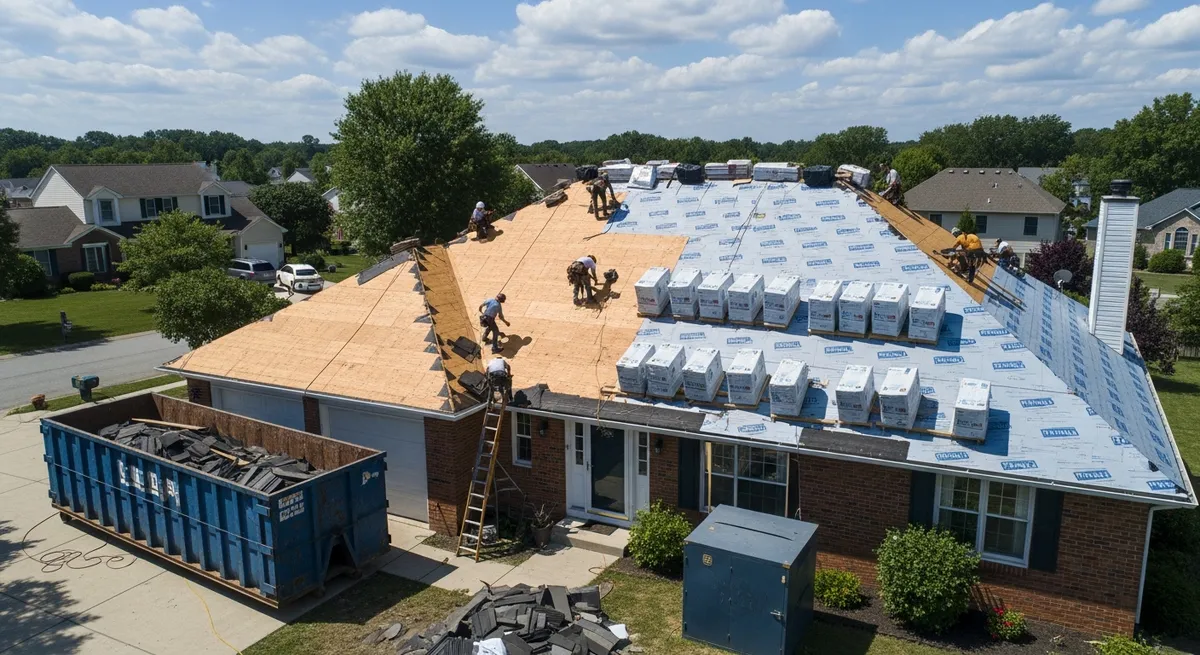
A well-run roof replacement follows a predictable sequence. The crew arrives between 7:00 and 8:00 a.m. They tarp shrubs and landscaping adjacent to the house, then begin tear-off immediately. Expect continuous noise from the first hour. Once the old material is off, the foreman walks the decking and flags any soft spots or rot. Any decking repairs should be shown to you and priced before the crew proceeds — not billed as a surprise on the final invoice.
Installation goes in order: ice and water shield at eaves and valleys, synthetic underlayment across the field, drip edge at eaves and rakes, then shingles from the bottom up. Flashing is reset at each penetration as the work reaches it. Ridge cap is the last thing installed before cleanup. A professional crew uses a magnetic roller to pick up nails from the yard and driveway. Before leaving, the foreman walks you around the perimeter and confirms when the permit inspection is scheduled. You should not have to chase anyone for final paperwork.