Roofing Contractors Rockville MD: Repairs, Replacement, and How to Compare Bids
Roofing Contractors Rockville MD: Repairs, Replacement, and How to Compare Bids
Key Takeaways
- Maryland MHIC license is required for all roofing contractors in Rockville — verify at the MHIC website before agreeing to any work
- Montgomery County requires permits for full replacements — a contractor who skips the permit creates liability for the homeowner
- Rockville’s mix of colonial, cape cod, and split-level homes means flashing geometry varies widely — experience with your home style matters
- Three written quotes allow meaningful comparison — scope differences in underlayment, flashing, and decking contingency affect total cost significantly
- Job-site cleanup and shingle disposal should be included in the quote, not added after the fact
Rockville Roofing Problems Homeowners See Most
Rockville sits in the heart of Montgomery County, Maryland, where the climate delivers a full range of weather conditions that test every roof throughout the year. Sterling Roofers serves Northern Virginia and nearby Maryland communities across the DMV, and we have spent years working with Rockville homeowners who face the same recurring roofing challenges season after season. Understanding what those challenges look like—and how they develop—gives you a significant advantage when it comes time to evaluate whether your roof needs attention and what kind of attention it actually requires.
The most common issue we encounter on Rockville roofs is shingle deterioration driven by the region’s intense summer heat and UV exposure. Asphalt shingles rely on a layer of ceramic granules embedded in their surface to reflect sunlight and protect the asphalt substrate from ultraviolet degradation. Over time, those granules loosen and wash away with rain, gradually exposing the underlying asphalt to direct UV rays. Once that process reaches a critical threshold, the shingles begin to curl, crack, and lose their ability to shed water effectively. If you notice dark streaks of granule accumulation in your gutters or bare patches on shingle surfaces that look slick or shiny compared to the textured areas around them, your shingles are telling you they have moved past their prime performance window and are heading toward the point where repairs or replacement become necessary.
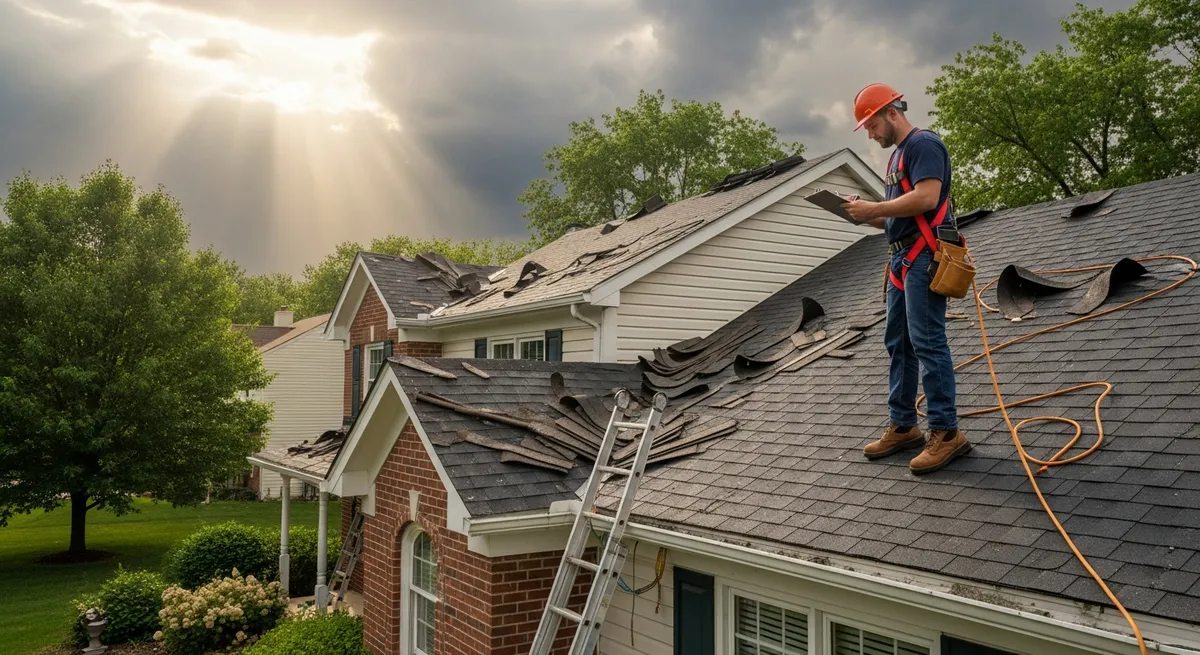
Wind damage is another frequent problem in the Rockville area, particularly during the spring and fall storm seasons that sweep through the Mid-Atlantic corridor. Strong gusts can lift shingle edges, break the adhesive seal strip that bonds each course of shingles to the one below it, and tear entire shingles free from the roof deck. The damage is not always immediately visible from the ground because a lifted shingle may settle back into position after the wind subsides, creating the illusion that everything is fine while the broken seal allows water to penetrate beneath the surface with every subsequent rain. This is why post-storm inspections are so valuable—a trained eye can spot the subtle signs of wind lift that a homeowner standing in the yard might easily miss.
Flashing failures around chimneys, skylights, vent pipes, and wall-to-roof transitions represent a disproportionate share of the leaks we diagnose in Rockville. Flashing is the metal or composite material that seals the joints where the roof surface meets a vertical structure, and it is one of the most vulnerable components of any roofing system because it must accommodate the constant thermal expansion and contraction of dissimilar materials. A chimney made of brick and mortar expands and contracts at a different rate than the wood framing and asphalt shingles surrounding it, and the flashing bridging that gap endures enormous stress over the years. When the sealant cracks or the metal fatigues, water finds its way into the gap and travels along hidden pathways inside the roof structure before showing up as a stain on your ceiling or wall—sometimes far from the actual point of entry.
Ice damming during Rockville’s winter months creates another category of problems that can be both destructive and confusing to diagnose. An ice dam forms when heat escaping from the living space below warms the upper sections of the roof, causing snow to melt and run down toward the eaves, where the roof surface is colder because it extends beyond the heated interior. The meltwater refreezes at the eave line, forming a ridge of ice that blocks subsequent meltwater from draining off the roof. That trapped water backs up under the shingle courses and seeps into the roof deck, insulation, and eventually the interior of the home. Addressing ice dams effectively requires understanding their root cause, which is almost always inadequate attic insulation, insufficient ventilation, or both. Simply removing the ice without correcting the underlying thermal dynamics means the problem will return with the next cold snap.
Gutter-related problems compound many of the issues described above. Clogged or damaged gutters prevent water from draining away from the roof edge efficiently, which increases the risk of fascia board rot, soffit damage, and foundation erosion. Rockville’s mature tree canopy means that many homes accumulate significant leaf and debris deposits in their gutters throughout the fall, and homeowners who skip seasonal gutter cleaning often discover the consequences the following spring when water overflows during heavy rains and saturates areas that should remain dry. Our gutter installation guide covers what proper gutter systems look like and how they integrate with your overall roofing system to protect your home from water damage.
Ventilation deficiencies are a silent contributor to premature roof aging that many Rockville homeowners are not aware of until a contractor points it out during an inspection. A properly ventilated attic allows hot, moist air to escape through ridge vents or other exhaust points while drawing cooler, drier air in through soffit vents along the eaves. When this airflow is blocked, restricted, or improperly balanced, heat and moisture build up in the attic space, accelerating shingle deterioration from below while promoting mold growth on the underside of the roof deck. The visible symptoms—wavy or buckled shingles, unexplained moisture stains, or a musty attic smell—often get attributed to roof age or exterior damage when the real culprit is inadequate ventilation underneath.
Signs You Need Repairs vs a Full Replacement
One of the most important decisions a homeowner faces when roofing problems arise is whether the situation calls for targeted repairs or a complete roof replacement. The answer is not always obvious, and choosing wrong in either direction has real financial consequences. Paying for a full replacement when a well-executed repair would have solved the problem wastes thousands of dollars. Continuing to patch a roof that has reached the end of its functional life wastes money on fixes that provide diminishing returns while leaving your home vulnerable to ongoing damage. The key is understanding the indicators that point in each direction and evaluating them honestly.
Repairs are generally the right call when the damage is localized, the rest of the roof is in good condition, and the roof has significant useful life remaining. A section of missing shingles from a wind event, a single flashing failure around a vent pipe, or a small area of damage from a fallen branch are all situations where a focused repair addresses the problem completely without disturbing the healthy portions of the roof. If your roof is less than 15 years old and the issue is confined to one area, repair is almost always the sensible and cost-effective choice. The repair should use materials that match the existing roof as closely as possible in terms of brand, color, and profile, and the contractor should integrate the new shingles seamlessly with the surrounding courses to maintain both weather protection and visual consistency.
The conversation shifts toward replacement when problems become widespread or recurring. If you are seeing deterioration across multiple sections of the roof—curling shingles on the south-facing slope, granule loss on the west side, flashing issues around the chimney, and soft spots near the valleys—these are signs that the entire roofing system is aging out rather than experiencing isolated failures. Replacing one section at a time in this scenario creates a patchwork of old and new materials with different remaining lifespans, mismatched appearance, and inconsistent performance. It also means paying for multiple crew mobilizations, multiple tearoffs, and multiple rounds of cleanup when a single comprehensive project would have been more efficient and delivered a better result.
Age is a major factor in the repair-versus-replacement calculus. Standard three-tab asphalt shingles in the Mid-Atlantic climate typically deliver 15 to 20 years of reliable service before they begin showing significant wear. Architectural shingles, which are thicker and more durable, generally perform well for 25 to 30 years under normal conditions. If your roof is approaching or has passed these age thresholds and you are dealing with multiple repair needs, the remaining useful life of the existing system is simply too short to justify continued investment in patching. A new roof resets the clock entirely, eliminates the accumulating risk of cascading failures, and often improves your home’s energy efficiency, curb appeal, and resale value in ways that make the investment worthwhile beyond just stopping leaks.
There is also a practical cost threshold that helps frame the decision. When the total you have spent or will spend on repairs within a few years exceeds roughly 30 percent of what a full replacement would cost, the financial logic tilts heavily toward replacement. At that point, you are investing significant money into an aging system that will continue to generate problems, and redirecting that spending toward a new roof gives you decades of worry-free protection instead of a series of temporary fixes. Our roof replacement cost guide breaks down the typical investment involved in a full replacement across the Northern Virginia and Maryland region so you can make an informed comparison.
Structural indicators override all other considerations. If any section of your roofline shows visible sagging, dipping, or deviation from a straight line, the underlying decking or framing has likely been compromised by prolonged moisture exposure. Sagging is not something that develops suddenly—it is the cumulative result of water infiltration over months or years—and it means the damage has progressed beyond what surface-level shingle repairs can address. A professional inspection that includes attic access and decking assessment is essential in this situation, and the findings will almost certainly point toward a full replacement with structural repairs as part of the scope.
What a Proper Estimate Should Include
The quality of a roofing estimate tells you a great deal about the contractor who prepared it. A thorough, detailed estimate demonstrates that the contractor took the time to inspect your roof carefully, understands the specific conditions affecting your home, and is committed to transparency about what the project involves and what it will cost. A vague, lump-sum quote with minimal detail suggests the opposite—and should raise immediate concerns about what you are actually agreeing to if you sign.
Every proper estimate from a roofing contractor Rockville professional should begin with a description of the current condition of your roof, supported by photographs taken during the inspection. These photos should document the specific damage or deterioration the contractor identified, including close-up images of problem areas like cracked flashing, missing shingles, granule loss, and any visible signs of water penetration. The photographs serve multiple purposes: they confirm that the contractor actually climbed up and examined your roof rather than guessing from the ground, they help you understand what needs attention and why, and they create a documented baseline that protects both you and the contractor throughout the project. If a contractor hands you an estimate without photos, ask yourself how confident you can be in their assessment of conditions they may not have examined closely.
Material specifications should be listed with enough detail that you can verify exactly what is being proposed. This means brand name, product line, color, and warranty tier for the primary roofing material, plus specifications for underlayment, ice-and-water shield, flashing materials, ridge cap, pipe boots, and any other accessories required for the installation. Generic descriptions like “architectural shingles” or “standard underlayment” are not sufficient because they allow the contractor to substitute lower-grade products without technically violating the agreement. You want to see something like “CertainTeed Landmark Pro in Weathered Wood” or “GAF Timberline HDZ in Charcoal”—product names that you can look up independently to verify quality, warranty coverage, and current market pricing. Visit our materials page for an overview of the roofing materials we recommend and install across the Rockville area.
Labor costs should be broken out separately from material costs so you can evaluate each component on its own merits. A single line item that bundles materials and labor into one number makes it impossible to determine whether the material pricing is fair, whether the labor rate is reasonable, or where adjustments might be possible if you need to bring the total closer to your budget. When labor is itemized, you can see exactly how much you are paying for the crew’s time, skill, and equipment, and you can compare that figure against the labor portions of other estimates to ensure consistency.
The scope of work section should describe every task the crew will perform in enough detail that there is no ambiguity about what is included and what is not. For a replacement project, this means specifying the tear-off process, the number of existing layers being removed, the disposal method and any associated fees, the decking inspection and repair approach, the installation sequence for underlayment, shingles, flashing, and accessories, and the cleanup procedure including magnetic nail sweeping. For a repair project, the scope should identify the exact location and nature of each repair, the materials being used, and the expected outcome. A well-written scope eliminates the most common source of disputes between homeowners and contractors: differing assumptions about what the project includes.
Timeline projections, payment terms, warranty details, and the change-order process round out a complete estimate. You should know when the project is expected to start, how long it will take under normal conditions, what weather-related delays look like, how payments are structured relative to milestones, what the manufacturer’s warranty covers versus the workmanship warranty, and what happens if the crew discovers unexpected damage during tear-off that requires additional work and cost. Every one of these details should be in writing before you sign anything, and any contractor who resists putting them on paper is not someone you want working on your home. Our roofing contract checklist provides a comprehensive list of items that should appear in every roofing agreement.
How to Choose a Contractor Without Stress
Choosing a roofing contractor does not have to feel like navigating a minefield. The process becomes manageable and even straightforward when you know what to evaluate and what questions to ask. The goal is to find a contractor who combines technical competence with honest communication, backs their work with meaningful warranties, and treats your home with the respect it deserves. Here is how to get there without the stress that so many homeowners associate with roofing projects.
Start with licensing and insurance, because these are the non-negotiable baseline requirements that separate legitimate roofing contractors Rockville MD professionals from unqualified operators. In Maryland, any contractor performing home improvement work exceeding $500 must hold a Maryland Home Improvement Commission license. This license confirms that the contractor has met the state’s requirements for financial responsibility and is registered with the regulatory body that handles consumer complaints. Verify the license number directly through the MHIC website rather than taking the contractor’s word for it. Insurance verification is equally critical: ask for a current certificate of insurance that lists both general liability coverage and workers compensation coverage, and call the insurance carrier directly to confirm the policy is active. This five-minute phone call protects you from enormous financial exposure if an accident occurs on your property during the project.
Experience matters, but it matters most when it is relevant to your specific situation. A contractor with 20 years of commercial flat-roof experience may not be the ideal choice for your residential steep-slope shingle project, and vice versa. Ask about the contractor’s experience with your specific roof type, material preferences, and any unique challenges your home presents, such as complex architectural features, steep pitches, multiple skylights, or chimney configurations. Request references from recent projects that are similar to yours in scope and complexity, and actually call those references. Ask them about the quality of the work, the crew’s professionalism, how the contractor handled any unexpected issues, and whether the project was completed on time and on budget. The answers will tell you more about what your experience will be like than any marketing materials or online reviews.
Communication quality during the estimate process is one of the most reliable predictors of overall project satisfaction. Pay attention to how the contractor communicates from the very first interaction. Do they return calls and emails promptly? Do they show up on time for the inspection appointment? Do they explain their findings clearly and answer your questions without condescension or impatience? Do they provide the estimate within the timeframe they promised? A contractor who communicates poorly before they have your money is not going to communicate better after they do. Conversely, a contractor who is responsive, thorough, and transparent during the estimate phase is demonstrating the same qualities they will bring to your project.
Red flags to watch for include high-pressure sales tactics, demands for large upfront payments, reluctance to provide written documentation, and any suggestion that the work should begin immediately without giving you time to review the estimate or obtain competing quotes. Legitimate contractors understand that homeowners need time to make informed decisions, and they are confident enough in their value proposition that they do not need to pressure you into signing before you have had a chance to think. Any contractor who insists on a same-day commitment or offers a “special price” that expires if you do not sign immediately is using a sales technique that prioritizes their convenience over your best interests.
Getting three estimates from different contractors is the standard recommendation, and there is good reason for it. Three quotes give you enough data points to identify a reasonable pricing range for your project, expose any outliers on the high or low end, and allow you to compare scopes of work and communication quality across multiple options. When comparing estimates, resist the temptation to default to the lowest price. Instead, compare the scopes of work to ensure each contractor is proposing equivalent materials, equivalent labor, and equivalent warranty coverage. A quote that is significantly lower than the others may reflect a less comprehensive scope, inferior materials, or missing elements rather than genuine cost savings. The best value comes from a contractor who offers quality materials, skilled installation, strong warranties, and clear communication at a fair price—not necessarily the cheapest one. Visit our service areas page to see the communities we serve throughout the DMV region.
Manufacturer certifications add another layer of confidence when evaluating roofing contractors in Rockville MD. Major shingle manufacturers like GAF, CertainTeed, and Owens Corning offer certification programs that require contractors to meet specific training, installation quality, and business practice standards. Certified contractors gain access to enhanced warranty options that non-certified installers cannot offer, which means choosing a certified contractor can result in significantly better warranty protection for your home. Certification is not a guarantee of perfection, but it does confirm that the contractor has invested time and effort in maintaining a higher standard of professional development than the minimum licensing requirements demand.
Typical Timelines and What to Expect on Job Day
Understanding the timeline for a roofing project takes much of the uncertainty out of the experience and helps you plan around the temporary disruption to your daily routine. While every project has its own variables, most residential roofing work in Rockville follows predictable patterns that give you a reliable framework for what to expect from the moment you sign the contract to the day the crew packs up and leaves your property.
The period between signing a contract and the actual start of work depends on the contractor’s current workload, material availability, and weather conditions. During peak roofing season—typically late spring through early fall—you may wait two to four weeks for a start date. During slower months, the lead time may be shorter. If your project involves special-order materials like a specific color or product line that is not commonly stocked, the material lead time may extend the schedule further. Your contractor should provide a projected start date at the time of signing and keep you informed of any changes as the date approaches. Be wary of any contractor who promises to start “tomorrow” unless you are dealing with an emergency situation, because legitimate contractors with steady business typically have schedules that reflect ongoing demand.
Minor repairs—replacing a section of damaged shingles, resealing a pipe boot, or addressing a flashing defect—are typically completed in a single visit, often in just a few hours. These are the kinds of projects where a small crew arrives in the morning, completes the specific repair, verifies the fix, cleans up, and leaves by early afternoon. If your project is a focused repair rather than a comprehensive replacement, you can generally expect minimal disruption to your day and a quick turnaround from start to finish.
A full roof replacement on a standard Rockville single-family home—typically ranging from 1,500 to 3,000 square feet of roof area—takes two to four days of active work under favorable conditions. The first day focuses on tear-off: the crew removes the existing shingles, underlayment, and any deteriorated flashing or accessories down to the bare decking. They inspect the exposed decking for moisture damage, rot, or structural issues, replace any compromised sections, and begin installing the new underlayment and ice-and-water shield in critical areas like valleys, eaves, and around penetrations. The second and third days involve installing the new shingle courses, step flashing, valley flashing, ridge cap, pipe boots, and all finish work. A fourth day may be needed for larger or more complex roofs, homes with multiple dormers or skylights, or situations where significant decking replacement extended the tear-off process.
On the day the crew arrives, expect them between 7:00 and 8:00 in the morning. They will begin by staging materials, setting up safety equipment including harnesses and roof brackets on steeper pitches, and placing tarps and protective barriers to shield your landscaping, walkways, siding, and any outdoor furniture or vehicles in the work zone. If you have garden beds, patio furniture, or fragile items near the house, move them to a safe distance the evening before the crew arrives. Roofing is inherently messy work that involves falling debris, and even the most careful crews cannot prevent all incidental contact with the areas directly below the roof edge.
Noise is a significant part of any roofing project, and it is worth preparing for. The work involves pneumatic nail guns, hammers, the heavy impact of material bundles being loaded onto the roof, power tools for cutting drip edge and flashing, and the scraping sound of old shingles being removed with flat shovels. If you work from home, plan for sustained noise throughout the workday from approximately 7:30 AM until late afternoon. If you have pets that are sensitive to loud or unfamiliar sounds, consider having them spend the day with a friend, at daycare, or in a room as far from the work area as possible. Most homeowners find that the noise, while disruptive, is tolerable because it is temporary and predictable—you know it will end when the crew finishes for the day.
End-of-day cleanup is a non-negotiable standard that every professional roofing crew should meet without exception. At the close of each workday, the crew should remove all debris from the roof, yard, driveway, and surrounding areas, bag and haul away old materials, and run a magnetic roller across every surface where nails could have fallen—including the lawn, flower beds, sidewalks, and paved areas. Stray roofing nails embedded in a tire weeks after a project is an entirely preventable problem that results from careless cleanup, and it is something you should never have to deal with if the contractor takes their responsibilities seriously.
The final walkthrough is the last step before you release final payment, and it deserves your full attention. The project manager or crew leader should walk you around the completed work, showing you the finished roof from ground level and pointing out key details like the flashing work, ridge cap installation, and any areas where they discovered additional issues during tear-off that were addressed or that you should monitor going forward. They should provide written documentation of the materials installed, the warranty terms and registration information, and their contact details for any follow-up needs. Take your own photos of the completed work for your records. These become valuable documentation if you ever file an insurance claim, sell your home, or need to reference the project specifications for future maintenance or warranty purposes.
Your Next Step
Finding the right roofing contractor Rockville professional for your project is ultimately about doing a reasonable amount of homework upfront so the project itself runs smoothly and delivers the result your home deserves. The steps outlined in this guide—understanding common roofing problems in the area, knowing when to repair versus replace, demanding a thorough estimate with photos and itemized details, evaluating contractors on substance rather than sales pitch, and preparing for what job day looks like—give you the knowledge and confidence to make good decisions without second-guessing yourself along the way.
Sterling Roofers brings over 15 years of experience to every project we take on across Northern Virginia and Maryland, including Rockville and the surrounding Montgomery County communities. We are licensed, insured, and committed to the kind of transparent communication and quality workmanship that turns a stressful home improvement decision into a straightforward, well-managed project. Whether your roof needs a targeted repair, a full replacement, or simply a professional inspection to understand where things stand, we are here to provide the clarity and craftsmanship you are looking for. If you are ready to take the next step, the process starts with a conversation—and we make that part easy.
If you suspect storm damage may be a factor in your roof’s condition, our storm and hail damage guide walks you through the signs to look for and how to navigate the insurance claims process effectively. For homeowners exploring related exterior projects, our commercial roofing checklist covers what to expect from larger-scale roofing projects in the Maryland and Northern Virginia market.
Schedule a Rockville Inspection with Sterling Roofers
Get a clear, photo-backed scope and an honest assessment of your roof’s condition. Call us at (703) 436-4445 or schedule online to get started.
Schedule Free Inspection