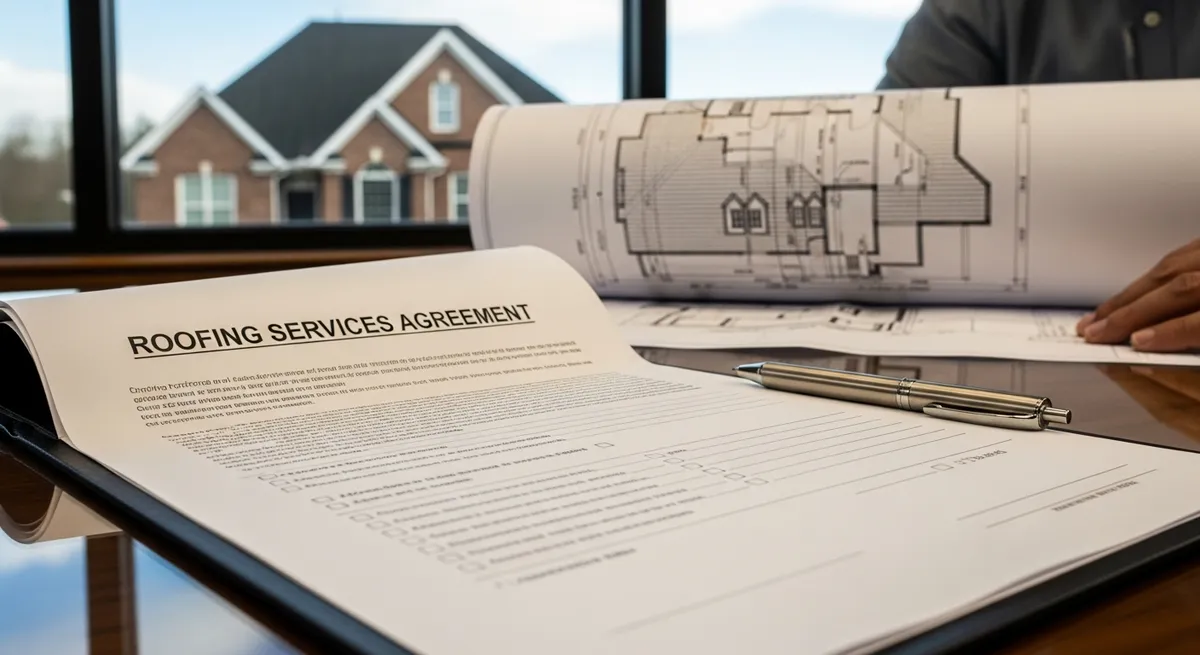
Questions for Roofing Contractor: Insurance, Estimates, and How to Estimate Roofing Jobs
Questions for Roofing Contractor: Insurance, Estimates, and How to Estimate Roofing Jobs
Key Takeaways
- Request a certificate of insurance verifying both general liability ($1M+ per occurrence) and workers compensation before allowing anyone on your roof
- A complete estimate specifies materials by brand and product line, not just “standard shingles”
- Contractors estimate roofing jobs by measuring the roof in squares (100 sq ft each), accounting for pitch, waste factor, and specific material and labor costs for your market
- A roofing tune up is worth it for a sound roof with isolated maintenance issues; it is not a substitute for repair when active leaks or systemic failure are present
- Verify Virginia DPOR contractor license at dpor.virginia.gov before signing any contract
Knowing the right questions for roofing contractor conversations is what separates homeowners who get clear, comparable estimates from those who end up comparing apples to oranges and choosing based on price alone. Sterling Roofers serves Northern Virginia and nearby Maryland communities across the DMV, and our estimators talk to homeowners every week who wish they had asked more specific questions before their last roofing project. This guide covers what to ask, what to listen for in the answers, and how contractors actually estimate roofing jobs — so you can evaluate what you receive.
The 10 Questions That Matter Most
These are the questions for a roofing contractor that reveal quality and accountability faster than any other screening method:
- “Can you provide a certificate of insurance showing general liability and workers comp?” — Non-negotiable. A contractor who hesitates or provides a COI you cannot verify is a red flag.
- “What is your Virginia contractor license number?” — Verify at dpor.virginia.gov. Class A or B license is required for work over $10,000 in Virginia.
- “Who is physically doing the work — your own crew or subcontractors?” — Neither is inherently bad, but knowing the answer tells you who is accountable and who to contact if there is a problem after the job.
- “What specific shingle brand, product line, and color are you quoting?” — “Standard architectural shingles” is not a specification. Ask for the exact product. There is a significant performance difference between an entry-level and a premium architectural shingle even within the same manufacturer’s lineup.
- “What is your plan for flashing?” — Will they replace all flashing, some flashing, or attempt to reuse existing? Reusing old step flashing on a new roof is a common cost-cutting practice that often leads to leaks at chimneys and dormers within 2–3 years.
- “How do you handle ventilation?” — Will they assess the existing ventilation and recommend changes, or simply re-install what is there? Inadequate ventilation voids most shingle warranties.
- “What is your decking policy — what happens if you find damaged decking after tear-off?” — Get the per-sheet or per-linear-foot rate in writing before the job starts. You do not want a surprise line item on the final invoice.
- “What does cleanup include?” — Will they use a trailer-mounted magnet for nail collection? How are gutters and landscaping protected? What happens to old materials?
- “What is your payment schedule and deposit amount?” — A normal deposit is 10–25% of the contract value. Requesting 50% or more upfront before work begins is unusual and a potential warning sign.
- “What warranties do you provide for both materials and your workmanship?” — Material warranty comes from the manufacturer; workmanship warranty comes from the contractor. Get both in writing with the contract.
Why an Insured Roofing Contractor Protects You
Working with an insured roofing contractor is not just about regulatory compliance — it is about who pays if something goes wrong. Here is the practical breakdown:
General liability insurance covers property damage that occurs as a result of the work. If a contractor’s crew drops a bundle of shingles onto your car, cracks a skylight during tear-off, or damages your landscaping, the contractor’s general liability policy covers the cost of repair or replacement. Without insurance, you may have no practical recourse other than small claims court.
Workers compensation insurance covers medical costs and lost wages for any crew member injured on your property. In Virginia, if an uninsured contractor’s worker is injured on your roof, you — as the property owner — may be exposed to liability for those costs. This exposure is the most serious risk of hiring an uninsured roofing contractor. Workers comp eliminates it entirely.
Verifying a COI: when you receive the certificate of insurance, call the insurance agent or broker listed on the document to confirm the policy is active and the coverage limits match what is shown. This step takes five minutes and eliminates the possibility of a forged or expired certificate.
How Contractors Estimate Roofing Jobs (Homeowner Version)
Understanding how to estimate roofing jobs from the contractor’s perspective helps you evaluate the estimate you receive. Here is the process:
Measurement: The contractor measures the roof area, typically by measuring the footprint of the house (in square feet) from the ground or from a satellite measurement tool, then applying a pitch multiplier to account for the slope. A 4:12 pitch adds approximately 7% to the flat area; a 10:12 pitch adds approximately 30%. The resulting number is divided by 100 to get the number of “squares” (1 square = 100 sq ft of roofing).
Waste factor: Roofing material is not installed without cut waste. A simple gable roof might have 8–10% waste. A complex hip roof with many valleys, dormers, and penetrations may have 15–20% waste. The contractor adds this factor to the measured square count before calculating material quantities.
Material cost: At current Northern Virginia pricing (as of 2026), architectural asphalt shingles cost approximately $90–$120 per square for material alone. Premium shingles (IKO Dynasty, GAF Timberline HDZ) run $110–$150 per square. Underlayment, drip edge, ice and water shield, nails, and ridge cap add approximately $25–$45 per square to the material total.
Labor cost: Residential roofing labor in Northern Virginia typically runs $60–$90 per square for a standard tear-off and re-roof on a moderately pitched house. Steeper roofs, limited access, multi-story homes, and complex layouts increase the labor rate. A 30-square house might see labor costs of $1,800–$2,700 for standard conditions.
Additional line items: Flashing replacement, decking repair, ventilation improvements, disposal fees, and permit fees (where required) are either included as lump sums or listed as per-unit costs in a transparent estimate. On a complete re-roof in Fairfax County, the full installed cost typically runs $8,000–$18,000 for a standard 2,000–2,500 sq ft home depending on material grade and roof complexity (as of 2026).
Roofing Tune Up: When It’s Useful, When It’s Not
A roofing tune up is a preventative maintenance service that addresses minor issues before they become active leaks. It typically includes:
- Re-sealing exposed nail heads and any shingle surface cracks with roofing sealant
- Replacing cracked or failing pipe boots and vent flashings
- Re-securing any lifting flashing at chimneys or wall junctions
- Replacing isolated damaged or missing shingles
- Clearing debris from valleys and gutters that might cause water backup
A roofing tune up is worth the investment when: the roof is structurally sound, the shingles have meaningful life remaining, and the issues identified are genuinely isolated and preventable. A homeowner with a 10-year-old roof that has a few cracked shingles and a failing pipe boot benefits from a tune up — those small issues addressed now prevent leaks that could cost far more in interior damage repair.
A roofing tune up is not appropriate when: there is active water infiltration, the shingles are in systemic granule-loss decline, the roof is over 20 years old, or the structural or flashing issues are widespread. In those cases, sealant and isolated patch work is a temporary measure that delays the inevitable and may mask damage from subsequent inspectors.
Clear Estimates and Honest Inspections Across Northern Virginia and Maryland
Sterling Roofers provides written, itemized estimates with photos so you know exactly what you are getting before you sign. We answer every question on this list — and more. Call (703) 436-4445 or schedule an inspection online.
Get a Clear Roofing Estimate