Storm Damage Roof Inspection: Hail, Wind, and What to Document
Storm Damage Roof Inspection: Hail, Wind, and What to Document
Key Takeaways
- Hail damage on shingles shows as circular granule displacement exposing dark asphalt or fiberglass mat — not just surface scuffs
- Wind damage presents as missing shingles, lifted tabs, and blown ridge cap — often on the windward-facing slopes
- Dents on soft metals (gutters, AC shrouds, pipe boots) are objective, non-disputable evidence of hail impact
- A written storm damage inspection report from a licensed contractor should be completed before the insurance adjuster visits
- Soliciting storm contractors who knock on your door after a storm is a red flag — verify license and insurance before allowing any inspection
A major storm hits Northern Virginia, and by the next morning you are staring at the yard wondering what happened to your roof. Shingles in the grass. Granules in the gutter. Maybe a ceiling stain you noticed for the first time. The roof has been hit, and now you need to know: how bad is it, is it covered, and what do you do next? A professional storm damage roof inspection is the first step in answering all three of those questions — and doing it right, before the insurance adjuster arrives, is what determines whether you get a fair settlement or a lowball assessment that doesn’t cover the real damage.
This guide covers exactly what storm damage looks like on a residential roof, what a professional storm damage roof inspection includes, how to document findings for an insurance claim, what to watch for when the insurance company sends an adjuster, and how to identify qualified storm roofing and construction contractors in the Northern Virginia market as opposed to the storm chasers who flood the area after every major weather event.
How to Recognize Hail Damage on a Roof
Hail damage to asphalt shingles is frequently misidentified or missed entirely during cursory inspections. The surface marks left by hail are specific and must be distinguished from normal shingle wear, blistering from manufacturing defects, or mechanical damage from foot traffic. Here is what genuine hail damage looks like:
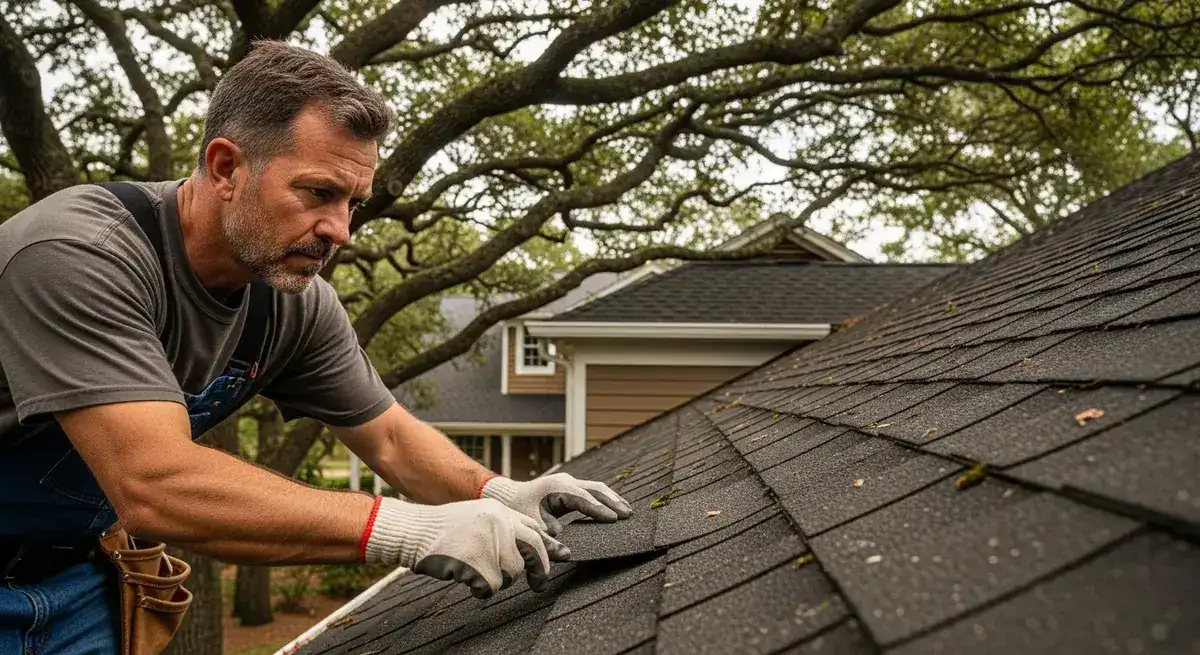
On asphalt shingles: Hail creates circular impact marks where the stone’s momentum has displaced or removed the protective granule layer from the shingle surface. The fresh impact point has a distinct visual signature: dark, circular, and soft to the touch because the asphalt beneath has been bruised — the granule adhesive has been disrupted and the underlying mat is no longer protected. Over the weeks following a storm, these impact points continue to lose granules as rain and wind work on the now-compromised surface, which is one reason that hail damage inspections should happen promptly rather than weeks later when the evidence becomes less distinct.
Hail damage is most visible from above at a low angle of light — early morning or late afternoon lighting across the surface of the shingles makes the texture change at each impact point clearly visible. From directly overhead in midday light, many impact marks are much harder to see, which is why some insurance adjusters performing quick, steep-angle inspections miss damage that a thorough inspector finds by physically walking the roof.
On soft metals — the most objective evidence: One of the most reliable indicators of hail damage is the pattern of dents on the soft metal components of your roof and exterior: gutters, downspouts, AC shrouds, pipe boot collars, ridge caps, and aluminum window trim. These surfaces dent clearly and permanently when struck by hail. The pattern, size, and density of these dents corresponds directly to the size of the hailstones and the density of the storm. When a field inspector performing a hail damage roof inspection near me assessment finds matching circular dents on gutters, pipe boots, and AC shrouds — all in the same size and density pattern — that is objective, non-disputable evidence that hail of a specific size struck the property.
On wood components: Wood fascia boards, siding, and window frames that were struck by hail show a characteristic orange-peel textured impact mark where the wood fibers have been compressed and fractured. These marks are different from general weathering, which follows the grain of the wood rather than creating discrete round impact patterns.
What hail damage is not: Normal granule loss from age, blistering from high attic temperatures, cracking from thermal cycling, or mechanical damage from someone walking the roof are sometimes misidentified as hail damage or cited by insurance companies as alternative explanations to avoid coverage. A trained inspector can distinguish hail damage from these other causes by the pattern, location, and physical characteristics of the damage. Age-related granule loss, for example, is distributed uniformly across the shingle surface, while hail impact marks are discrete, circular, and spaced with the irregular pattern of actual stones.
Wind Damage Roof Repair: What You’re Actually Looking At
Wind damage presents differently from hail damage and is often more immediately visible because it typically involves shingles that are missing, lifted, or torn. Here is the full picture of wind-related roof damage:
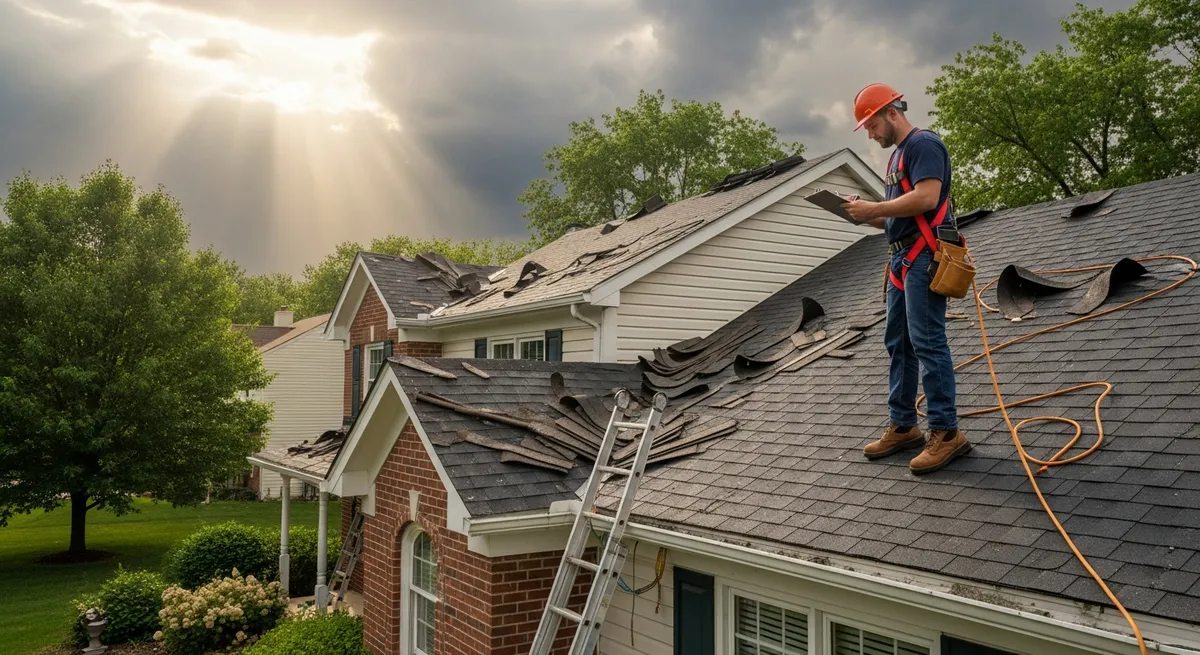
Missing shingles: The most obvious form of wind damage. Shingles go missing when wind force exceeds the combined resistance of the nailing and the thermal seal strip that bonds the tab to the course below. This happens most readily on: shingles that were under-nailed during installation, shingles where the seal strip has lost adhesion due to age, and shingles that are already cracked or brittle. Once one shingle lifts, the wind gets under the course above and a cascade can occur — a single wind event can remove dozens of shingles in a short section of roof because of this propagation effect.
Creased and lifted tabs: Wind damage does not always result in shingles leaving the roof entirely. Often, the wind lifts the shingle tab far enough to crease it at the nail line, then releases — and the tab falls back into approximate position but no longer adheres correctly. These creased tabs are easy to miss in a drive-by assessment because the shingle appears to be in place. But the crease breaks the watertight overlap with the course above, and the detached seal strip means the tab will lift again in the next wind event, potentially taking the shingle with it.
Ridge cap loss: The ridge cap is the highest point of wind exposure on any residential roof, and it often sustains loss in wind events that leave the field shingles intact. Missing or shifted ridge cap sections create an immediate opening at the peak of the roof where wind-driven rain can enter from both sides. This is also a common point of underestimation by adjusters who focus on visible shingle loss in the field and don’t fully account for ridge damage.
Roof repair wind damage patterns: Wind damage concentrates on specific slopes based on wind direction and building geometry. In a typical Northern Virginia thunderstorm, the predominant wind is from the south or west, so the south-facing and west-facing slopes experience the most direct loading. When inspecting for wind damage, start with these windward slopes and check for progressive damage on adjacent slopes where the wind turbulence around the ridge and eave creates secondary stress points.
Wind damage roof replacement thresholds: When wind damage results in missing shingles across multiple sections, affects more than 25% of the total roof area, or is found on a roof that is over 15 years old with pre-existing granule loss, the case for wind damage roof replacement rather than repair becomes stronger. Insurance adjusters evaluate both the scope of damage and the overall roof condition when determining whether a claim supports repair or replacement. A thorough inspection report that documents both the storm damage and the pre-existing condition of the surrounding areas provides the clearest basis for this determination.
What a Professional Storm Damage Roof Inspection Includes
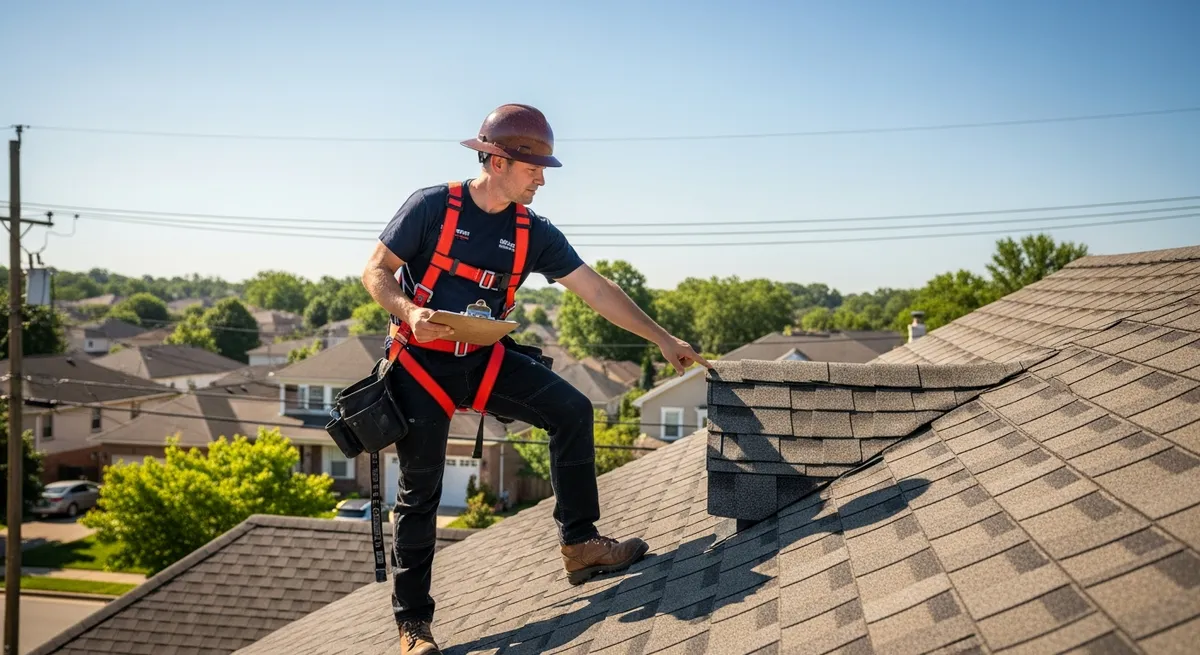
A professional storm damage roof inspection is more systematic and thorough than a general condition inspection. Here is what it should cover:
- Full roof surface walk. The inspector accesses all sections of the roof and walks them systematically, not just the most accessible slopes. Damage patterns that appear on one slope but not others provide evidence about storm direction and intensity.
- Shingle surface assessment for each slope. The inspector evaluates granule displacement, impact marks, creased or lifted tabs, missing sections, and condition of the seal strip on lifted shingles. Findings are recorded by slope and location.
- Soft metal inspection. Every soft metal component is checked: gutters, downspouts, pipe boots, ridge caps, chimney caps, drip edge, and any HVAC equipment on or adjacent to the roof. Dent patterns, size, and density are noted and photographed.
- Flashing and penetration assessment. All flashing is checked for impact damage, seal disruption, or lifting caused by wind forces during the storm. Existing flashing failures that predate the storm are noted separately so they are not included in the storm damage claim.
- Attic interior check. The underside of the decking is examined for new water staining or active moisture that indicates storm-related infiltration. Fresh staining in areas without prior history is documented as post-storm intrusion.
- Ground-level evidence collection. Granules in gutters and downspout outlets, shingles or ridge cap pieces in the yard, and dents on exterior metal components at ground level all provide corroborating evidence for the inspection findings.
- Written report with photographs. The completed storm damage roof inspection results in a written report documenting all findings with supporting photographs. This report is your primary documentation for the insurance claim and should be in hand before the insurance adjuster’s visit.
Preparing for the Insurance Adjuster: What to Document First
The insurance claims process for storm damage roof repair or replacement is significantly more favorable to homeowners who have professional documentation in hand before the adjuster arrives. Here is the step-by-step approach:
Step 1 — File your claim promptly. Most insurance policies require storm damage claims to be filed within a specific period — often one year from the date of loss, but some policies have shorter windows. File the claim as soon as you have reason to believe damage occurred, even before the inspection is complete. You can always provide additional information after filing; you cannot extend the filing deadline after it has passed.
Step 2 — Schedule a professional inspection before the adjuster visits. Request a hail damage roof inspection near me from a licensed roofing contractor before the insurance company sends their adjuster. The inspection produces a written report with photographs documenting all storm damage findings. This gives you an independent, objective record of the damage that you bring into the adjuster meeting — rather than relying entirely on the adjuster’s assessment, which is conducted on behalf of the insurance company.
Step 3 — Document with your own photographs. Before any repair work is done, photograph the damage from the ground with a zoom lens and, if safe and accessible, from the roof. Document: missing shingles by slope, hail dents on gutters and soft metals, any interior water damage (ceiling stains, wet insulation), and the date and time stamps on the photos. Weather service records confirming the storm event in your area complement the visual documentation.
Step 4 — Have your contractor present at the adjuster inspection. Request that your roofing contractor be present when the insurance adjuster performs their inspection. The contractor can walk the adjuster through the documented findings, point out damage that might be missed by a quick review, and explain the technical significance of specific damage patterns. This step alone often improves claim outcomes significantly.
Step 5 — Understand your policy type. An ACV (Actual Cash Value) policy pays replacement cost minus depreciation, calculated based on the roof’s age and condition. On a 15-year-old roof, the ACV payment may cover only 40–50% of replacement cost. An RCV (Replacement Cost Value) policy initially pays ACV but releases the remaining depreciation amount (the “recoverable depreciation”) after the work is completed and documented. Know which type you have before the adjuster meeting — it determines how you manage the financial planning for the repair or replacement.
Post-Storm Roof Inspections in Northern Virginia and Maryland
Sterling Roofers performs professional storm damage roof inspections across Fairfax, Loudoun, Prince William, Arlington, and Maryland. Written reports, insurance support, licensed and insured. Call (703) 436-4445 or schedule online.
Schedule Your InspectionFinding a Qualified Storm Roofing and Construction Contractor
After a significant hail or wind event in Northern Virginia, the roofing market changes overnight. Door-to-door solicitation increases dramatically. Out-of-state contractors who follow storm tracks arrive in numbers. Some of these contractors are legitimate and experienced; many are not. Identifying the difference requires the same due diligence as hiring any contractor, applied with more urgency because the post-storm market moves fast and pressure tactics are common.
What defines a qualified storm roofing and construction contractor:
- Virginia contractor license. Verify at dpor.virginia.gov. A license number should be provided without hesitation. For storm damage work involving insurance, ask specifically whether the contractor is experienced with the insurance documentation and supplement process — this is a specific skill set, not all licensed contractors have it.
- Active local presence. A contractor who has been operating in Northern Virginia with a verifiable physical address has more accountability than one who arrived from another state following the storm. Ask how long they have been in the market and for local references from non-storm work.
- Insurance inspection experience. The contractor you hire after a storm should be familiar with how insurance adjusters assess damage, what documentation is needed, and how to identify supplement opportunities when the initial claim settlement is inadequate. This is a specific competency. Ask directly: “Have you done insurance claim work in Northern Virginia before, and can you support me through the claims process?”
- No “we’ll work with your insurance so you pay nothing” promises. A contractor who tells you they will get your deductible waived or that you will pay nothing out of pocket is making a promise that is either illegal (it constitutes insurance fraud in Virginia to waive a deductible), financially unrealistic, or both. Legitimate usa storm roofing and construction group operations do not make these promises. You are responsible for your deductible, and any contractor who says otherwise is operating outside ethical standards.
Red flags that should end the conversation immediately:
- Soliciting your door uninvited within 48 hours of a storm
- Unable or unwilling to provide a Virginia contractor license number
- No verifiable local address or phone number (a local area code is not the same as a local presence)
- Requests for your insurance policy information before completing the inspection
- Pressure to sign a contract before you have reviewed the inspection findings
- Offers to waive your deductible or claims of “zero out-of-pocket cost to you”
Storm Damage Inspection Cost: When Is It Free?
Most reputable roofing contractors in Northern Virginia provide storm damage inspections at no charge when there is a reasonable likelihood of storm-related damage and a potential project resulting from the inspection. The inspection is part of the contractor’s business development process — if the inspection finds damage and the homeowner moves forward with the contractor for repairs or replacement, the inspection cost is embedded in the project scope.
A free storm damage inspection is appropriate and normal. It is not an obligation — a contractor who provides a free inspection is not owed your business, and you are free to use their written report when meeting with other contractors or discussing the claim with your insurance company.
Some contractors charge for inspections when the property is in a remote location, when the homeowner is clearly not interested in having repair work done (using the inspection purely for insurance documentation purposes without any intent to use the contractor), or when the property involves unusual access complexity. These are reasonable exceptions. For a standard residential storm damage inspection in Northern Virginia, expect no charge from established local contractors.