Missing Shingles Repair: What to Do First, What It Costs, and How to Prevent Repeat Damage
Missing Shingles Repair: What to Do First, What It Costs, and How to Prevent Repeat Damage
Key Takeaways
- Missing shingles expose underlayment to the elements — treat this as urgent, not something to watch through the next storm
- Missing roof shingles repair cost in Northern Virginia runs $300–$700 for small sections; larger areas run $600–$1,500+
- Underlayment beneath missing shingles should always be inspected before replacement shingles are installed
- How to repair missing shingles properly requires correct nail placement and sealant — improper DIY repair often creates new leak paths
- Repeat shingle loss usually signals an installation problem, not just bad luck with the weather
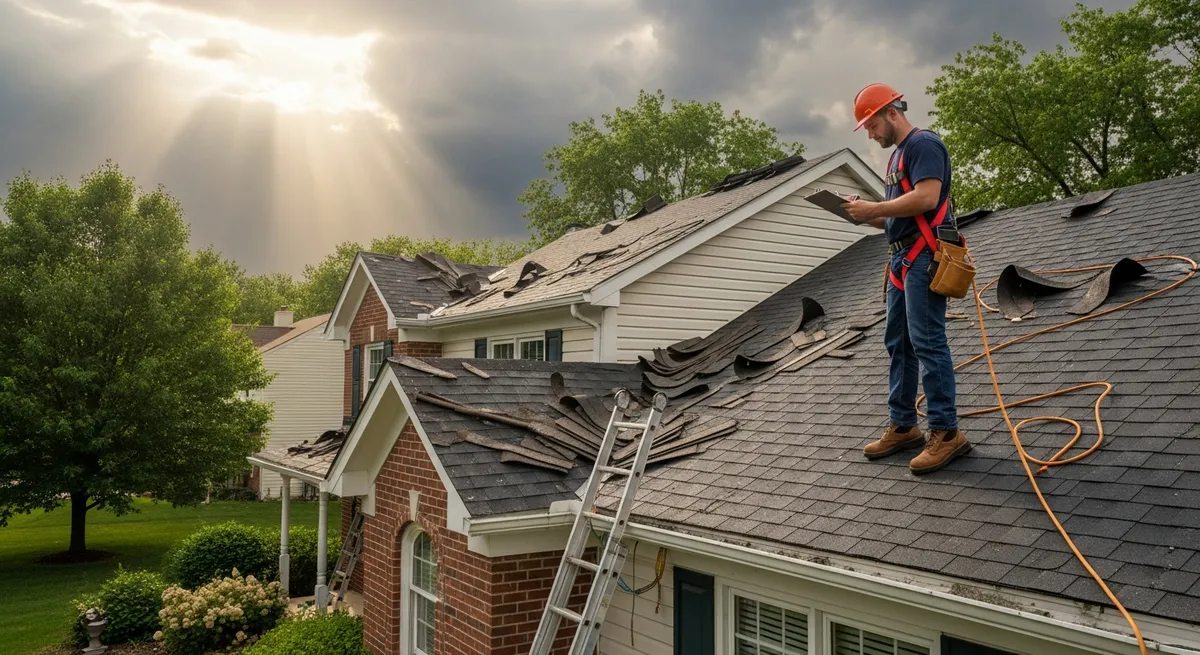
You noticed it after the last storm — a dark patch on the roof where the shingles used to be, or a few shingles sitting in the yard that came off the south slope overnight. Now you’re asking yourself: will my roof leak with missing shingles before a contractor can get there? The short answer is yes, eventually — and possibly sooner than you think, depending on where the shingles went missing and what’s below them. This guide tells you exactly what to do right now, what a professional missing roof shingles repair involves, what it costs in Northern Virginia and the DC metro area, and how to prevent the same problem from happening again.
Missing shingles are one of the most common calls we receive after Northern Virginia thunderstorm seasons. The mid-Atlantic storm pattern brings sustained wind gusts that regularly reach 40–60 mph, which exceeds the standard 60 mph wind rating of many residential shingles — particularly older ones that have become brittle and lost adhesion over time. Understanding why your shingles went missing is as important as replacing them, because if the cause isn’t addressed, the repair is a temporary fix rather than a durable solution.
Will My Roof Leak with Missing Shingles?
The honest answer depends on where the shingles are missing and how long they’ve been gone. Here is the full picture:
What’s under missing shingles: Every residential roof has two layers of protection against water: the shingles themselves, and the underlayment beneath them. When shingles are missing, the underlayment is exposed. Most modern underlayments — 30-lb felt or synthetic underlayment — are water-resistant and will shed water through several rain events when intact. But underlayment is not designed for ongoing UV exposure or direct water load over weeks or months. It degrades when exposed, develops micro-tears from sun and wind, and eventually allows water through.
High-risk locations for immediate leaking: Missing shingles at the ridge line are the most urgent — the ridge is the highest point of water vulnerability, and any gap there allows wind-driven rain to enter from multiple directions. Missing shingles in a valley — where two roof planes meet — are similarly urgent because valleys concentrate large volumes of water in a narrow channel, and any gap in the valley waterproofing layer allows that water to find a path into the home. Missing shingles adjacent to chimney or pipe boot flashing are also high-risk because any gap disrupts the seal that keeps water from running down the penetration and into the framing.
Lower-risk but still urgent locations: A missing shingle or two in the middle of a large roof field on a relatively new roof with intact underlayment may not leak immediately. But “not leaking yet” is not the same as “safe to defer indefinitely.” Exposed underlayment degrades rapidly under direct sun and wind, and there is no way to know from the ground whether the underlayment is intact beneath the missing section without a physical inspection.
The practical answer: Treat missing shingles as an urgent repair regardless of location. If you have missing shingles and rain is in the forecast within 48 hours and a contractor cannot get there in time, covering the exposed area with a heavy polyethylene tarp anchored with sandbags or secured to the ridge is a legitimate temporary measure. Do not nail through the roof to secure a tarp — the additional penetrations create new leak points. Call a contractor to repair missing roof shingles as soon as scheduling allows, and do not let an exposed area persist through multiple storm cycles.
What Causes Shingles to Go Missing
Understanding why shingles went missing determines whether a repair is sufficient or whether a broader problem needs to be addressed:
Wind damage from storms: The most common cause in Northern Virginia. Shingles have a rated wind resistance — most residential architectural shingles are rated for 110–130 mph when new. But that rating assumes proper installation with the correct number of nails in the correct nailing zone. Shingles that were installed with too few nails, nails driven too close to the shingle edge, or nails placed outside the nailing zone have an effective wind rating much lower than their label. When gusts hit 50–60 mph during a typical Northern Virginia summer thunderstorm, under-nailed shingles lift from the bottom tab and separate at the seal strip. Once one shingle lifts, the wind gets under the next course and a cascade begins.
Age-related adhesion loss: Shingles are held in position by two mechanisms: mechanical fastening with roofing nails and thermal adhesion via a self-sealing strip that bonds the tab to the course below under warm conditions. As shingles age past 15–20 years, the self-seal strip loses flexibility and adhesion strength. A shingle that was fully bonded at year 10 may lift freely at year 22 because the seal has simply released over years of thermal cycling. These shingles come off in lower wind events than newer shingles would — a 40-mph gust that wouldn’t disturb a newer roof will send older shingles into the yard.
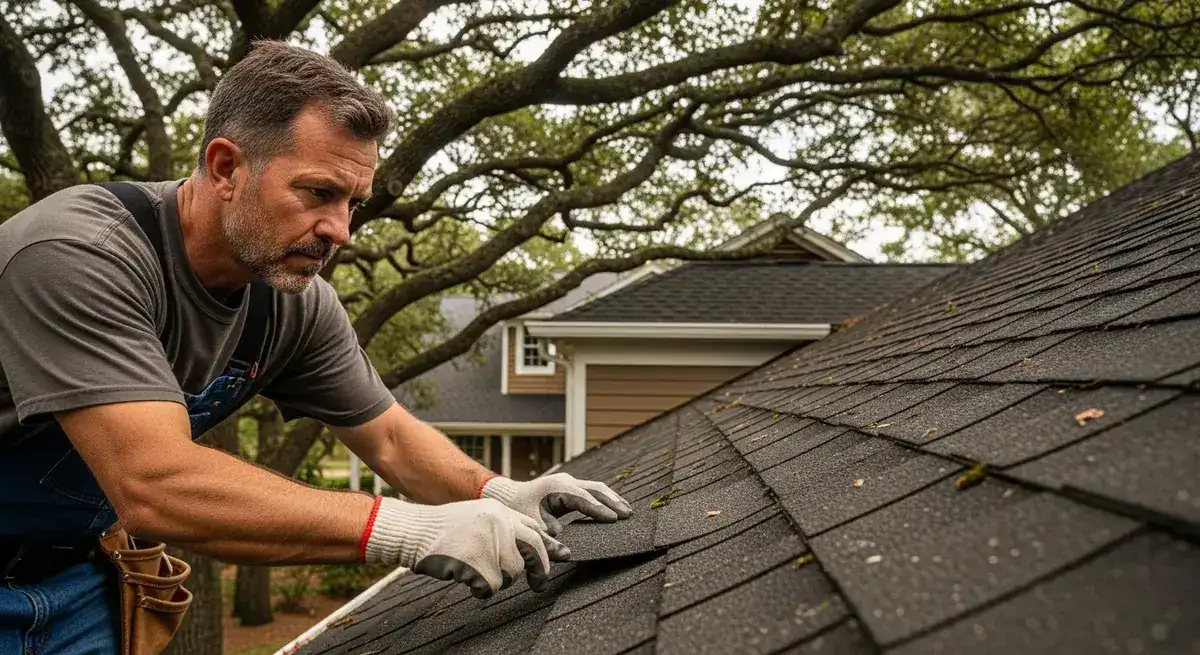
Impact damage: Tree branches, falling debris, and in some Northern Virginia neighborhoods, wildlife activity can physically remove or dislodge shingles. Impact damage is typically localized to one area and the cause is usually identifiable — there will be a limb in the yard or marks on the surrounding shingles that indicate the impact point.
How to Repair a Missing Shingle on a Roof: What Professionals Do
Knowing how to repair a missing shingle on roof correctly explains both why professional repair produces better results than DIY attempts and what you should verify a contractor is doing during the work:
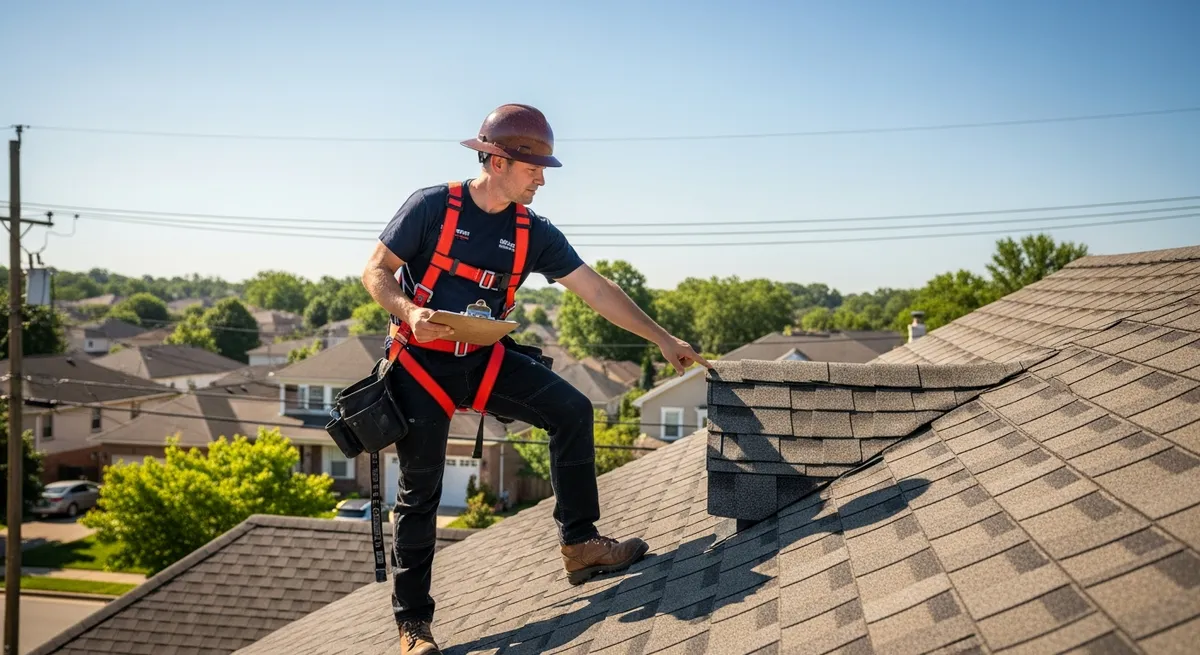
Step 1 — Inspect the underlayment. Before any replacement shingle is installed, the underlayment in the exposed area is examined for integrity. Tears, bubbling, or discoloration indicates moisture has already penetrated or UV degradation has weakened the layer. If the underlayment is compromised, it is repaired or replaced with a matching piece before the shingle goes on. Skipping this step — installing a shingle over damaged underlayment — leaves a leak path directly beneath the new material.
Step 2 — Match and prepare replacement shingles. The replacement shingle is matched to the existing product for color, thickness, and exposure. On newer roofs with common active products, this is straightforward. On older roofs with discontinued colors, the contractor may need to source from specialty suppliers or discuss the color variance with the homeowner before proceeding. The replacement shingle is cut to the correct length if the missing piece was a partial tab.
Step 3 — Install with correct nailing. The replacement shingle is slid into position under the tabs of the course above it, lifting the adjacent shingles carefully to avoid cracking them — particularly on cold days when older shingles are brittle. Roofing nails are driven in the correct nailing zone (typically 1 inch from each edge and 1 inch above the tab notches for standard shingles). The correct nail length must penetrate through the new shingle, through the existing shingles below, and at least 3/4 inch into the decking.
Step 4 — Seal all nail heads and tab edges. Exposed nail heads in the repair area are covered with roofing cement. The tab edges of the replacement shingle and any adjacent tabs that were lifted during installation are sealed with roofing cement to restore the thermal bonding function that the self-seal strip provides on new shingles. This step is frequently skipped in low-quality repair work and is one of the primary causes of repairs that fail in the next wind event.
How to repair missing roof shingles at the ridge requires additional steps: existing ridge caps must be carefully removed from both sides of the gap, the new ridge cap piece installed in the correct overlap orientation, and adjacent pieces re-nailed and sealed. The ridge is the highest-stress location on the roof and must be treated as such during repair — it cannot simply be patched with roofing cement.
Missing Shingles Repair Cost in Northern Virginia: 2026 Ranges
| Repair Scenario | Low End | High End | Notes |
|---|---|---|---|
| 1–5 missing shingles (field, low pitch) | $300 | $550 | Includes underlayment inspection, matching shingles, labor, sealant |
| 6–20 missing shingles (larger section) | $500 | $950 | May include partial underlayment patch |
| Ridge cap missing (per linear foot) | $14 | $28 | Minimum visit charge applies; most urgent location to repair |
| Storm damage — multiple areas (estimate) | $600 | $1,500 | Insurance may cover; get written inspection before adjuster visit |
| Underlayment patch (per sq ft, if needed) | $3 | $7 | Change-order item if underlayment found damaged during inspection |
| Decking replacement (per sheet, if rotted) | $80 | $140 | Requires your approval before proceeding; additional change-order item |
Prices shown are typical missing shingles repair cost ranges for Northern Virginia as of 2026. All repairs carry a minimum visit charge of $250–$350. Contact us for a free written estimate specific to your roof.
When Missing Shingles Require More Than a Repair
Not every missing shingle situation is a simple swap. Here are the scenarios where the discovery of missing shingles should prompt a conversation about replacement rather than repair:
- Shingles went missing across multiple sections simultaneously. When a storm removes shingles from the north slope, the south slope, and the east facing simultaneously, that pattern suggests the entire shingle system has compromised adhesion — the self-seal strips have failed system-wide. Repairing each section individually buys time but does not solve the underlying problem.
- The roof is over 20 years old. If your roof is approaching the end of its rated life and shingles are beginning to go missing, you are at the beginning of an accelerating failure pattern. Repairing individual sections now while planning for a full replacement within the next two to three years may be the right strategy — but only if the repair cost is low relative to the timeline. If repairs are becoming frequent, accelerating the replacement timeline is usually more economical.
- The underlayment beneath has been saturated. If an inspection finds that the underlayment beneath the missing shingles has been wet long enough to allow water to reach the decking — evidenced by staining or soft spots — the scope has expanded beyond a shingle replacement into a repair that requires addressing the decking and potentially the framing below. At that point, a full assessment of the roof’s condition is warranted before deciding whether to repair or replace.
Emergency Shingle Repair in Northern Virginia
Sterling Roofers responds quickly to post-storm missing shingle situations across Fairfax, Loudoun, Prince William, Arlington, and Alexandria. Don’t wait through the next rain. Call (703) 436-4445 or book an inspection online.
Book Your InspectionPreventing Future Shingle Loss
After completing a missing shingles repair, the conversation with your contractor should include why the shingles went missing and what can be done to prevent recurrence:
- If under-nailing was the cause: The repair itself corrects the nailing in the repaired section. But if under-nailing is systemic across the roof, the entire roof has elevated vulnerability in subsequent storms. Ask your contractor to assess whether the nailing appears consistent across the visible field — if the problem is widespread, a full replacement with correctly installed shingles is ultimately the only permanent solution.
- If age-related adhesion loss was the cause: There is no repair that restores the thermal seal strip function on old shingles. The repair stabilizes the current damage, but shingles that have lost their adhesive bond will continue to be susceptible. Trimming overhanging branches that act as wind sails and reduce turbulence at the roof surface helps marginally, but planning for replacement within the next two to five years is the realistic path.
- For the next replacement: Request a shingle product with a Class H wind rating (110 mph or higher) and verify that the specification includes six nails per shingle rather than the standard four on high-wind zones of the roof. This incremental upgrade adds minimal cost to a full replacement and significantly improves wind resistance for the life of the new roof.
Our storm damage roof repair guide covers how to evaluate storm damage, document it for insurance, and find a contractor who can address both missing shingles and any related impact damage from the same event.